Androgenetic alopecia is the most common cause of hair loss in both men and women. You may know it as male or female pattern hair loss, and you will sometimes see it called androgenic alopecia. According to MedlinePlus, it affects an estimated 50 million men and 30 million women in the United States.
The good news is that it is very treatable, especially when you start early. Here is what causes androgenetic alopecia, how to recognize it and which treatments can help.
Table of Contents
What Is Androgenetic Alopecia?
Androgenetic alopecia is a genetic, hormone-driven form of hair loss. Over time, affected hair follicles shrink in a process called miniaturization. Each new hair grows back shorter, finer and lighter, until some follicles stop producing visible hair altogether.
Unlike temporary shedding, it is progressive. Without treatment, it tends to continue.
What Causes Androgenetic Alopecia?
It comes down to a combination of genes, hormones and time.
Genetics
Many people believe baldness is inherited only from your mother’s side. In reality, many genes are involved, and they can come from either parent. A family history of thinning on either side raises your risk.
DHT
The main hormone involved is dihydrotestosterone (DHT), which the body makes from testosterone. In people who are genetically sensitive, DHT binds to hair follicles and gradually shrinks them. Women produce DHT too, and its effects can become more noticeable as estrogen levels fall around menopause. Learn more in our guide What Is DHT?
Age
Risk increases with age, but it can start as early as the late teens or 20s. If you are noticing thinning early, read about hair thinning in your early 20s.
Signs of Androgenetic Alopecia in Men
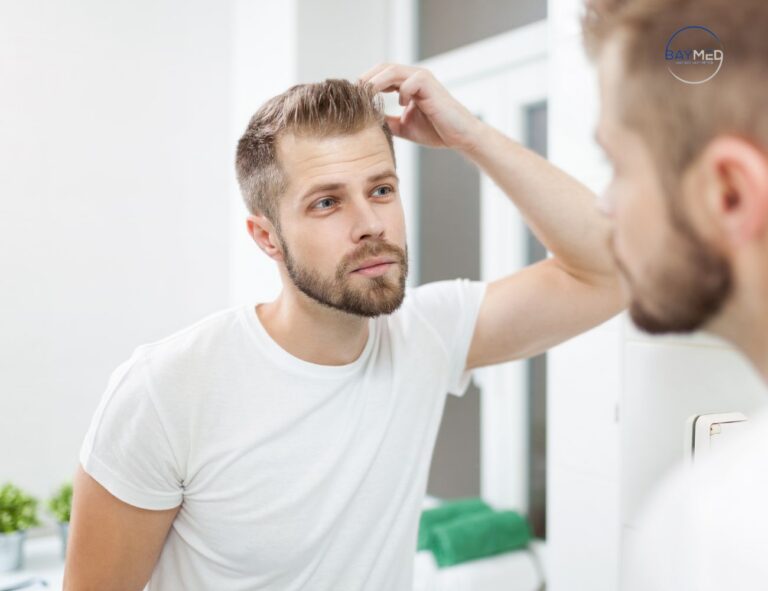
In men, it usually follows a predictable pattern:
- A receding hairline at the temples, often forming an M shape
- Thinning at the crown, on the top back of the head
- Over time, the two areas can meet, leaving hair mainly around the sides and back
Doctors track this progression using the Norwood scale.
Signs of Androgenetic Alopecia in Women
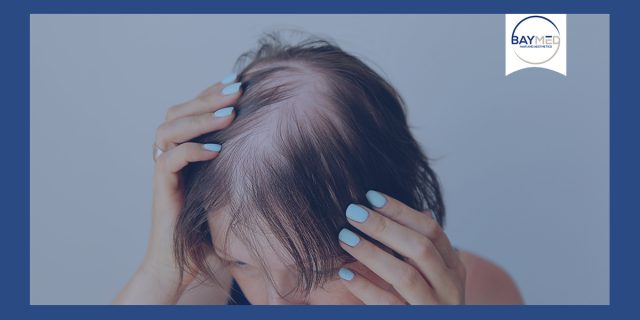
In women, the hairline usually stays in place. Instead, you may notice:
- A widening part
- Overall thinning on the top of the head
- A smaller ponytail or more visible scalp in bright light
Complete baldness is rare in women, but thinning can still have a real impact on confidence. Hormonal changes during perimenopause and menopause often make it more noticeable.
How Is Androgenetic Alopecia Diagnosed?
A hair loss specialist can usually diagnose it from your history and a close look at your scalp, including the pattern of thinning and signs of miniaturized hairs. Because other conditions, such as thyroid problems, iron deficiency or telogen effluvium, can look similar, blood work may also be recommended.
At BayMed, genetic testing for hair loss adds another layer of insight into your risk and helps personalize your treatment plan.
Can Androgenetic Alopecia Be Treated?
There is no permanent cure, because the genetic sensitivity stays with you. But treatment can slow or stop further loss and, in many cases, regrow hair. The earlier you start, the more hair you keep. Thinning often is not obvious until a significant amount of density has already been lost, so it pays to act on early signs.
Medications
Topical minoxidil is FDA-approved for both men and women. Oral finasteride, which lowers DHT, is FDA-approved for men. Both work only while you keep using them, so your provider will explain whether either is right for you.
Regenerative Treatments
PRP hair restoration and exosome therapy use growth factors to strengthen weakened follicles and improve thickness. Juvasonic combination therapy offers a needle-free way to deliver targeted topical solutions into the scalp.
Laser Therapy
Capillus RX low-level laser therapy is an at-home laser cap that stimulates follicles to support regrowth and thicker hair.
Hair Transplant
For more advanced hair loss, ARTAS robotic hair restoration moves healthy, DHT-resistant follicles from the back of the scalp to thinning areas for natural, long-lasting results.
Why Choose BayMed Hair & Aesthetics?
At BayMed Hair & Aesthetics in St. Petersburg, FL, Dr. Stavros Papandreou and our team focus on hair loss every day. We start by finding out exactly what is behind your thinning, then build a personalized plan that may combine medical, regenerative and surgical options. Explore all of our hair restoration treatments.
Frequently Asked Questions
Is androgenic alopecia the same as androgenetic alopecia?
Yes. Both terms describe the same condition. Androgenetic alopecia is the medical term, and androgenic alopecia is a common variation.
Can women get androgenetic alopecia?
Yes. It is the most common cause of hair thinning in women. It usually shows up as a widening part rather than a receding hairline.
Will my hair grow back?
Follicles that have shrunk but are still active can often be revived with treatment. Follicles that have been inactive for a long time are unlikely to regrow, which is why early treatment matters and why a transplant may be the best option for areas that are already bald.
When should I see a specialist?
As soon as you notice a receding hairline, a widening part or thinning at the crown. Book a hair loss consultation to get a clear diagnosis and a plan.
Summary
Androgenetic alopecia is a common, genetic form of hair loss driven by DHT. It affects men and women differently, and it tends to progress without treatment. Today’s options, from medication and PRP to laser therapy and ARTAS hair transplants, can slow hair loss and restore density.
If you are noticing thinning, book a consultation with BayMed Hair & Aesthetics in St. Petersburg to find the right treatment for you.