When people consider a hair transplant, one question usually comes first: will it look natural? The answer depends largely on a step that happens before a single follicle is moved: hairline design.
A well-designed hairline frames your face, suits your age and blends in so naturally that no one can tell you had a procedure. A poorly planned one can look artificial or age badly. Here is why hairline design matters, what goes into it and how to make sure your new hairline looks right for years to come.
Table of Contents
Why Hairline Design Matters
Your hairline is the first thing people notice. Even a technically perfect transplant can look unnatural if the hairline is too low, too straight or the wrong shape for your face.
Good hairline design is part science and part art. It considers your facial proportions, your current and future hair loss, and the amount of donor hair available to you.
What Makes a Hairline Look Natural?
- A soft, irregular edge. Natural hairlines are never perfectly straight. Small irregularities and a gradual transition from fine single hairs at the front to denser hair behind them make the result believable.
- The right height. A hairline placed too low can look out of place and may not suit you as you age.
- Defined temples. The temple points and corners of the hairline frame your face and play a big role in a natural look.
- Correct direction and angle. Each graft needs to match the direction your hair naturally grows.
Mature vs. Juvenile Hairlines
Most men start out with a low, straight juvenile hairline. Through the late teens and twenties, many naturally shift to a mature hairline that sits slightly higher and recedes a little at the temples. This is normal and is not necessarily a sign of balding.
Recreating a teenage hairline at 45 rarely looks right, and it uses up donor hair you may need later. A mature, age-appropriate hairline usually looks more natural and holds up better over time.
What Is an M-Shaped Hairline?
An M-shaped hairline forms when hair recedes at the temples while the center stays in place, creating the shape of the letter M. In men, it is often an early sign of androgenetic alopecia. A transplant can soften or fill in the temples, but how much depends on your age, how stable your hair loss is and your donor supply.
Who Is a Good Candidate for Hairline Restoration?
Not everyone with a receding hairline is ready for a transplant. A review on deciding surgical candidacy in pattern hair loss highlights that careful patient selection is key to a good outcome. In general, good candidates have:
- Hair loss that has slowed or stabilized
- Enough healthy donor hair at the back and sides of the scalp
- A healthy scalp without active inflammation or scarring conditions
- Realistic expectations about density and results
Younger patients and people with diffuse thinning may be advised to stabilize their hair loss first with treatments such as PRP hair restoration or medication, so their new hairline still looks right as they age.
Can You Reshape Your Hairline?
In many cases, yes. A transplant can lower a high hairline, rebuild receded temples or soften an uneven shape. Women with naturally high foreheads can also be candidates for hairline lowering with grafts.
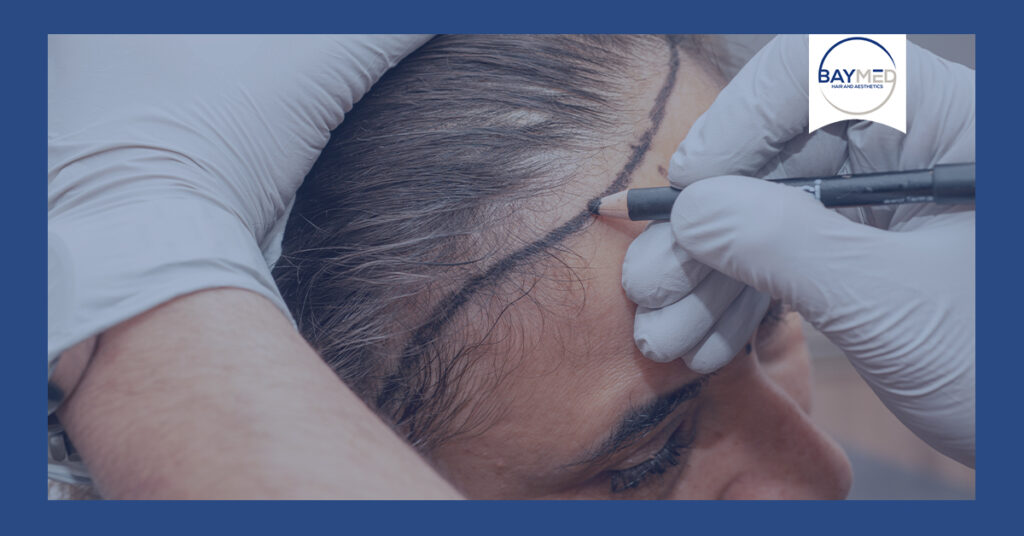
During your consultation, your surgeon will draw the proposed hairline on your scalp so you can see it before you commit.
How ARTAS Supports a Natural Result
At BayMed, we use ARTAS robotic hair restoration, which uses advanced 3D technology to help create an individualized hairline design. Its AI identifies and harvests the best follicles with robotic precision, with no linear scar and no stitches. Dr. Stavros Papandreou and our surgical team then place each graft at the right angle and direction so the hairline looks natural.
Curious how this compares to older methods? Learn more about FUE vs. FUT hair transplants.
Why Choose BayMed Hair & Aesthetics?
Hairline design is where experience matters most. At BayMed Hair & Aesthetics in St. Petersburg, FL, Dr. Stavros Papandreou and our surgical team take the time to plan a hairline that fits your face, your age and your long-term hair loss, with experience designing hairlines for patients of different ethnic backgrounds. Explore our ARTAS robotic hair restoration.
Frequently Asked Questions
How long does it take to see a new hairline?
Transplanted hairs usually shed in the first few weeks, then begin to regrow after about three to four months. Most people see significant results at around nine to twelve months.
Will a hair transplant hairline look natural?
With careful design and skilled placement, yes. Modern techniques use fine single-hair grafts at the front and a soft, irregular edge, so the result looks like your own natural hairline.
Can I choose any hairline I want?
Your surgeon will work with you on your goals, but the final design has to fit your face, age and donor supply. A hairline that looks good today also needs to look good in 20 years.
Do women get hairline transplants?
Yes. Women may choose a transplant to lower a high hairline or restore thinning at the temples.
Summary
Hairline design is the foundation of a natural-looking hair transplant. The right hairline suits your face and age, uses your donor hair wisely and keeps looking good as you get older.
If you are considering a transplant, book a consultation with BayMed Hair & Aesthetics in St. Petersburg to see what your new hairline could look like.